Why Your Supplier Choice is a Safety Decision
In the high-end home fragrance market, a candle jar is more than just a vessel—it is a thermal pressure container. Choosing a supplier based solely on the lowest price per unit is the most common mistake brands make. In 2026, with the surge in glass raw material costs and stricter global safety mandates (like ASTM F2179), brands must look beyond aesthetics. You need a partner who understands thermal shock resistance, wall thickness distribution, and chemical coating stability.
We have audited the global landscape to rank the top 10 manufacturers. Whether you are a Fortune 500 fragrance house or a scaling luxury brand, this list provides the technical clarity you need.
To qualify for this list, each manufacturer was evaluated against four industrial KPIs:
ASTM F2179 Compliance
Can the glass withstand a 40°C temperature delta without fracture?
Dimensional Tolerance
Does the neck diameter vary by more than ±0.5 mm? (Critical for wick centering)
Decoration Durability
Will the matte or metallic finish peel when the wax reaches 60°C?
Supply Chain Agility
MOQ flexibility and lead-time reliability in a post-2025 logistics world.
1. Ranking Criteria: The “No-Fluff” Benchmark
To qualify for this list, each manufacturer was evaluated against four industrial KPIs:
2. The Global Top 10 Manufacturers
01. STD GLASS (China) – The Engineering-First Specialist

- Best For: Luxury brands requiring bespoke OEM designs with high technical precision.
- The Difference: STD GLASS bridges the gap between massive industrial factories and artisan studios. While others sell “stock bottles,” we provide Engineered Vessels.
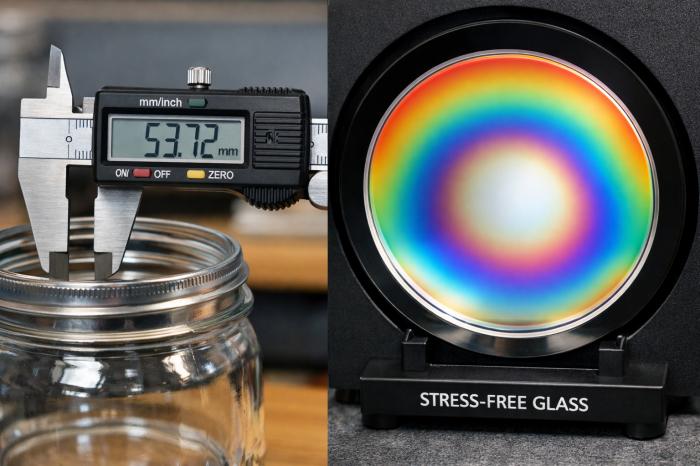
- Technical Edge: We utilize Polarized Light Stress Analysis on 100% of custom orders to eliminate internal cooling tension. Our proprietary coating process ensures that matte black and electroplated finishes are thermally bonded, preventing the “peeling” issues common in cheap wholesale glass.
- MOQ: 10,000 units (Scalable for premium growth).
02. Libbey (USA) – The Mass-Market Standard

- Best For: Classic “Status” jars and high-volume retail staples.
- Pros: Incredible stock availability in the US and a long heritage of food-grade safety.
- Cons: Very limited customization for small-to-medium brands. If you want a unique mold or a specific gradient finish, the lead times and MOQs can be prohibitive.
03. Stoelzle Glass Group (Austria) – The Luxury Flint Authority

- Best For: Ultra-premium fragrance houses requiring “Extra-Flint” (ultra-clear) glass.
- Pros: Their glass has a diamond-like brilliance. They are the masters of the “heavy-base” look with zero air bubbles.
- Cons: Extremely high price point and long transatlantic shipping cycles.
04. Owens-Illinois (O-I Glass) – The Sustainability Giant
- Best For: Large-scale eco-conscious brands requiring high recycled content.
- Pros: The global leader in PCR (Post-Consumer Recycled) glass integration.
- Cons: Their focus is on industrial-scale production (millions of units). For boutique or medium luxury brands, getting personalized service is difficult.
05. Anchor Hocking (USA) – The Apothecary Original
- Best For: Thick-walled, durable “Apothecary” style jars with glass lids.
- Pros: Iconic American styling and superior thermal tempering.
- Cons: Limited innovation in modern luxury finishes (e.g., iridescent or 3D textures).
06. Bormioli Luigi (Italy) – The Designer’s Choice

- Best For: Candles that double as home decor statement pieces.
- Pros: Italian design at its finest. They specialize in complex internal geometries and high-clarity glass that makes wax colors “pop.”
07. Verescence (France) – The High-Fashion Pioneer
- Best For: Brands that want their candles to look like perfume bottles.
- Pros: They are the world leaders in luxury glass decoration—think 3D etching and “Verre Infini” (infinite glass) recycling tech.
08. [Hebei Artisan Glass] (China) – The Borosilicate Specialist
- Best For: Thin-walled, high-heat resistant artisan candles.
- Pros: Specializes in borosilicate glass (like Pyrex), which is virtually immune to thermal shock. Perfect for “double-walled” candle designs.
09. [Guangdong Deco-Glass] (China) – The Finish Experts
- Best For: Brands where the “look” is everything.
- Pros: Masters of post-processing. They can achieve any texture—from “velvet touch” to “mercury silver”—at a fraction of European costs.
10. Vetropack (Switzerland) – The European Precision Power

- Best For: Regional European brands requiring strict ISO 9001 and ISO 14001 compliance.
- Pros: Extreme consistency in glass weight and wall thickness, ensuring a predictable burn for every single candle.
Inside the Factory: How to Spot a “Red Flag” Supplier
Don’t be fooled by a pretty showroom. When auditing a factory, look for these three things:
- The Adhesion “Grid Test”: Ask the supplier to perform a cross-cut test on a coated jar. If the paint flakes off in the grid, it will peel when your candle heats up.
- Neck Finish Consistency: Measure the internal diameter of 10 random samples. If the variance is $>1mm, your wick testing will be useless.
- Bottom Centering: Look at the bottom of the jar. If the glass is significantly thicker on one side, the jar will heat unevenly, leading to a “hot side” that can crack.
Vetting a supplier requires a clear set of specifications. To ensure you’re asking these top-tier factories the right questions, review our master guides on [Defining your Product (Jar vs. Vessel)] and our [Step-by-Step Selection Checklist] before sending your RFQ.